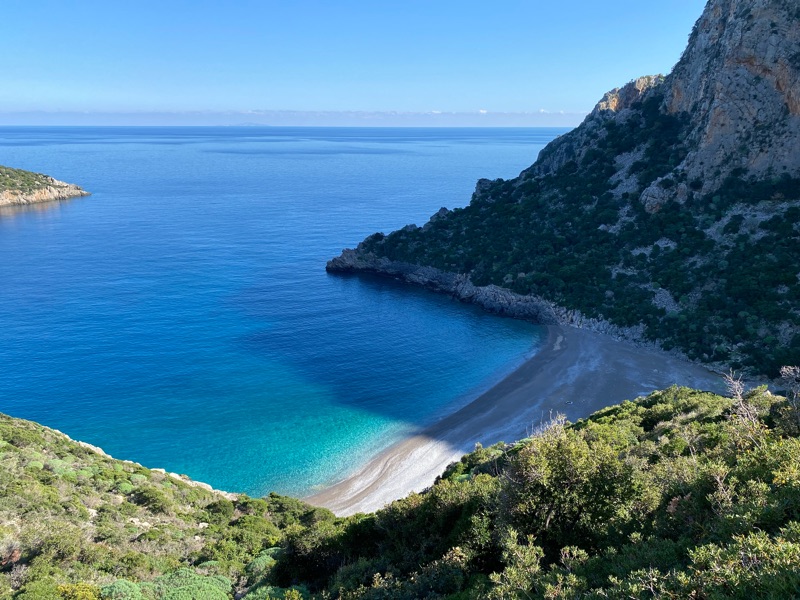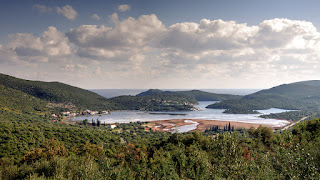


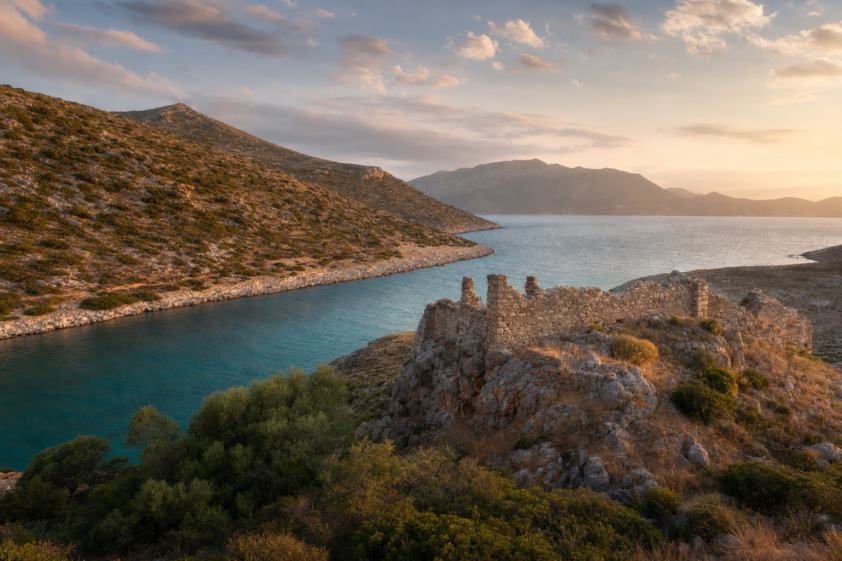
On the eastern coast of Laconia, where the sea winds its way nearly a mile inland to form the only fjord in Greece, lies a city with a history stretching back almost 3,500 years. This is ancient Zarax (or Zarakas), the town that gave its name to an entire region and that lives on today through the picturesque settlement of Gerakas.
A Hero and a Name
According to the traveler Pausanias, who passed through here in the 2nd century AD, the city took its name from the Lacedaemonian hero Zarex (or Zarakas), who founded it sometime between 1300 and 1200 BC. Zarex, son of Petraeus the king of Karystos, was a figure steeped in myth: he is said to have learned music from Apollo himself and to have had a hero shrine (heroon) as far away as Eleusis in Attica.
There is also a more “linguistic” explanation for the name. By one interpretation, “Zarax” derives from the intensifier za (meaning “very much”) and rax (from the verb rhegnymi, “to break”), conveying the sense of a steep, precipitous place — an image that fits perfectly with the rocky promontory above the harbor.
On the Border of Two Great Powers
Zarax’s location was neither accidental nor harmless. The city sat just south of the disputed regions of Thyreatis and Kynouria — precisely the lands where, for centuries, the two great powers of the age clashed: Sparta and Argos.
After the famous Battle of Thyrea in 546 BC, Zarax is thought to have passed into Spartan hands. It was a fortress-town, a “perioikis” of Sparta, whose strategic value far exceeded its size. Its status shifted again after Philip II‘s victory at the Battle of Chaeronea (338 BC), which upended the balance of power across the Peloponnese.
The Safe Harbor
What made Zarax truly valuable was its harbor. Pausanias described it as a “town with a good harbor” — a place with an excellent, sheltered anchorage. Indeed, the narrow fjord of Gerakas offers complete protection from the winds of the Myrtoan Sea, something rare along the entire eastern Laconian coastline.
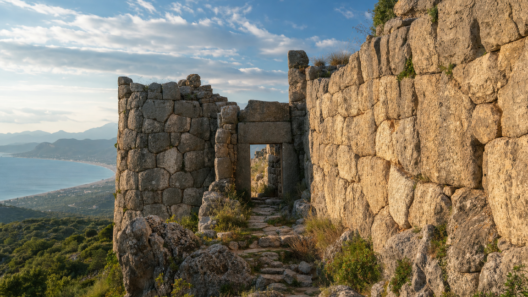
The city’s prosperity is directly tied to this harbor. Maritime trade brought wealth, and that wealth in turn explains the impressive walls that were later raised to protect the town. Zarax was never a conquering power; it chose isolation and quiet, living off the sea and its natural fortress.
The Great Destruction
Its heyday, however, came to a violent end. In 272 BC, the Spartan Cleonymus, son of King Cleomenes II, seeking to seize power from his nephew Areus, called on Pyrrhus, king of Epirus, for help. In the midst of this civil strife, Zarax suffered a devastating blow — it was, as Pausanias notes, the only Laconian town that Cleonymus “left depopulated,” reducing it to ruins.
Despite the blow, the city showed remarkable resilience: just a few decades later, in 219 BC, it successfully defended itself against the Spartan king Lycurgus. From its very beginnings, the story of Zarax was one of survival on the frontier between great powers.
A City That Left Its Name to Time
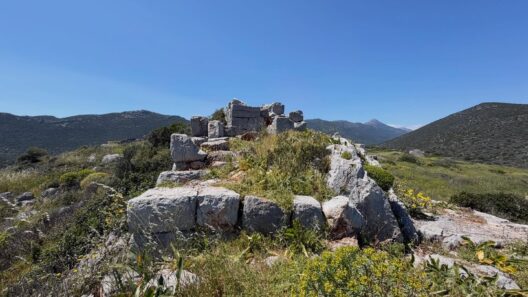
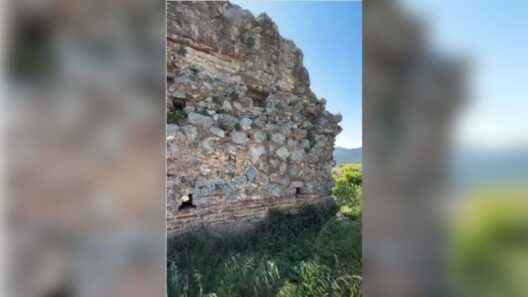
Even if today the ruins are scarce and hard to make out among the mastic bushes and brambles, Zarax survives in an unexpected way: its name lives on in the wider region, gradually transformed into the Byzantine “Ierax” and finally into today’s Gerakas.
In the next article, we’ll climb the hill above the harbor to get up close to the acropolis, the impressive Hellenistic walls, and the archaeological secrets that the soil of Zarax still keeps hidden.
Sources: Pausanias, “Description of Greece” (III, 24) · Wikipedia — Zarax