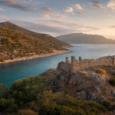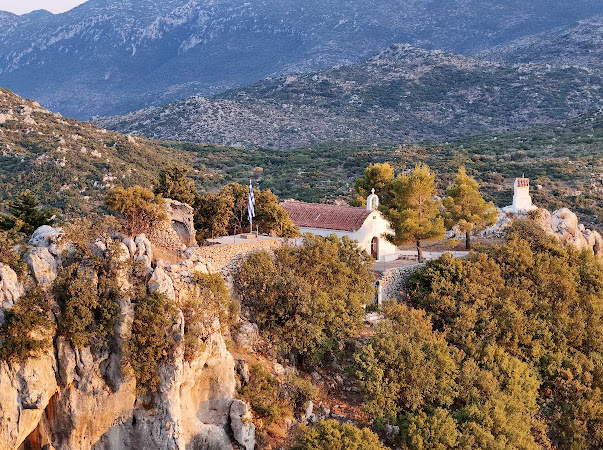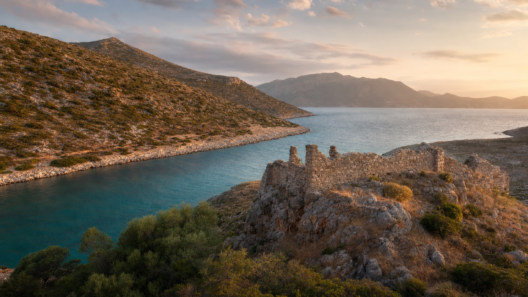


Above the harbor of Gerakas, at the southern tip of a small rocky peninsula, a visitor climbing the path encounters something arresting: walls that have stood upright for more than two thousand years. These are the fortifications of ancient Zarax, one of the best-preserved examples of Hellenistic fortification in Laconia.
A Natural Fortress, Reinforced by Human Hands
Zarax’s location was chosen with military logic. The rocky hill, with its steep slopes, offered natural protection. But the inhabitants didn’t stop there: during the Hellenistic period, they built an impressive fortification wall enclosing both the town and the acropolis.
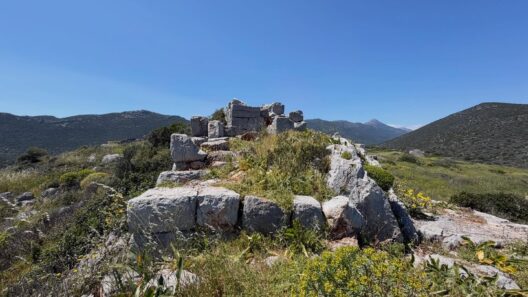
The line of the outer enclosure survives today mainly on the north and west sides of the archaeological site, where the walls are preserved to a great height. The defense was reinforced by at least eight towers, rectangular or square in plan, while in some places traces of later repairs can be seen — proof that the wall was maintained and used for centuries.
The Acropolis: The Last Refuge
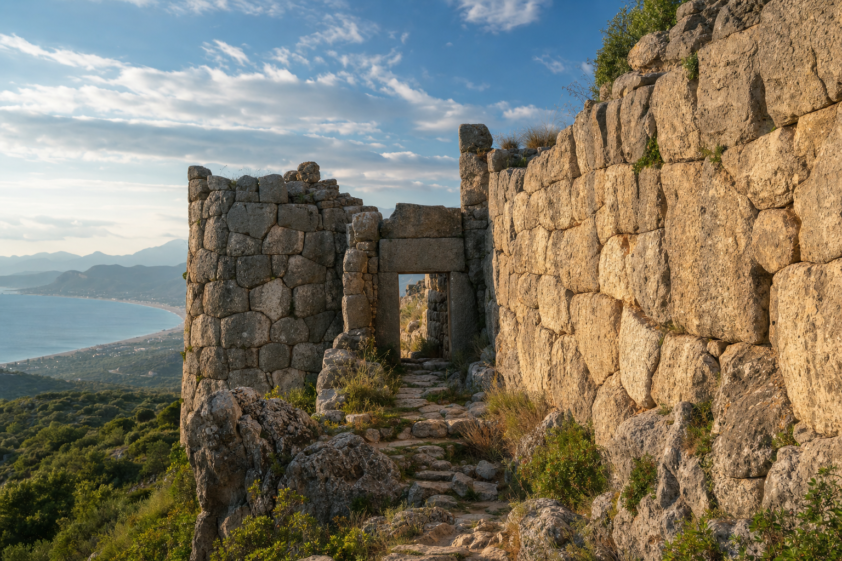
On the eastern part of the site, where the steep slope offered natural protection, rose the acropolis. It was the last refuge in times of great danger, as well as a probable dwelling place for the garrison. On its north and west sides it was surrounded by a wall built in an irregular polygonal style, using massive limestone blocks, while the sheer eastern slope protected it on its own.
A Gate That Was a Trap
The most impressive feature of the fortification is the gate of the acropolis, in the northwest corner of the wall. Its defense was reinforced by a solid, circular tower. The entrance passage, dated to the years after 272 BC, takes the form of a narrow corridor just one meter wide, which runs north and then bends to the east.
It was a masterpiece of defensive engineering. In times of danger, the passage was closed with wooden doors at two points. Even if the enemy broke through the first door, they faced a second — in total darkness, in a corridor so narrow that any attack was rendered nearly impossible.
The Lost Temple of Apollo
When Pausanias visited Zarax in the 2nd century AD, he found the city in decline. He noted that the only notable building remaining was a temple of Apollo with the cult statue of the god in the type of Apollo the lyre-player — a detail that points directly back to the myth of the founder Zarex, who had learned music from Apollo.
Remarkably, the ruins of this temple have not yet been located. It remains one of the great unsolved mysteries of the site, awaiting the archaeologist’s spade.
Roman and Christian Layers
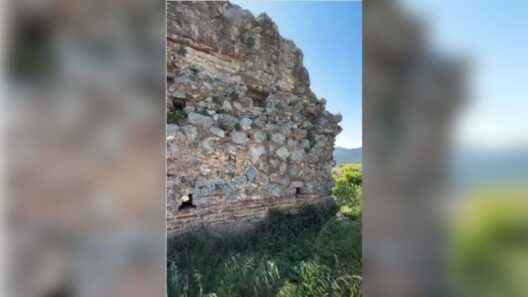
The site of Zarax is not one-dimensional. Between the two defensive walls, high up, one can see the remains of Roman-era buildings. Particularly striking is a vaulted building from the Roman period, built with a mixed masonry technique and preserved to a remarkable height. Its type and exact dating remain unclear, since the site has never been systematically excavated.
In the area of the acropolis, finally, survive the remains of a three-aisled early Christian basilica, built in late antiquity — proof that life on the hill continued even after the triumph of Christianity.
A Place That Waits
One of the most fascinating things about Zarax is precisely this: it has never been systematically excavated. What the visitor sees today — the walls, the towers, the gate, the vaulted building, the basilica — is only the surface. Beneath the soil still lie the stories of centuries, from prehistory to Byzantium.
In the next and final article, we’ll follow the city through its great transformation: from ancient Zarax to the Byzantine Ierax and, finally, to today’s Gerakas.
Source: Wikipedia — Zarax